In industrial facilities, commercial buildings, and power distribution systems worldwide, single phase digital panel mount AC voltmeters are trusted to provide accurate voltage readings day after day. Operators rely on these instruments to maintain safe operating conditions and protect sensitive equipment. But there is a question that rarely gets asked — and the answer might be more alarming than you think.
Modern electrical grids are subject to a wide range of disturbances. Among the most damaging are momentary overvoltages — brief spikes in voltage that last anywhere from a few milliseconds to several seconds. A lightning strike nearby, the switching of large inductive loads, or a fault elsewhere on the grid can all generate these dangerous events. When your single phase digital panel mount AC voltmeter fails to detect them, the consequences can ripple throughout your entire operation.
At Gomelong, we have spent more than 15 years manufacturing energy meters and digital panel instruments for the global market. Our experience has shown that many facility managers and engineers assume their panel meters are capturing everything happening on their lines. But is that assumption justified?
Momentary overvoltages are not rare events. They occur more frequently than most operators realize. The difference between a meter that captures these events and one that misses them often comes down to a single specification: response time.
Traditional analog voltmeters have inherent limitations. Their moving coils require mechanical movement to indicate a reading, introducing natural damping that slows their response to rapid changes. While this smooths out short-term fluctuations on the display, it also means the operator never sees brief overvoltage events.
Digital meters operate differently. They sample the input voltage at discrete intervals, convert those samples into digital values, and then calculate and display the result. The sampling rate and processing speed determine whether a momentary overvoltage is captured or completely missed.
The following table illustrates how different response times affect the detection of momentary overvoltages:
| Response Time | Captures Transient Events | Typical Application Suitability |
|---|---|---|
| ≥ 1 second | Minimal — most momentary spikes missed entirely | Simple presence indication, low-criticality monitoring |
| 500 ms - 1 s | Limited — captures only longer-duration events | General power monitoring, non-sensitive equipment |
| 200 ms - 500 ms | Moderate — detects some switching transients | Industrial applications with moderate sensitivity |
| ≤ 200 ms | High — captures the majority of momentary overvoltages | Sensitive equipment protection, quality assurance |
| < 50 ms | Exceptional — near-real-time detection | Critical infrastructure, laboratory-grade monitoring |
Many standard digital panel meters on the market have response times exceeding one full second. In that time, a damaging overvoltage spike can come and go completely unnoticed by the measuring instrument — even while sensitive downstream electronics may be sustaining cumulative or immediate damage.
Even if a meter's response time is relatively fast, there is another consideration. Most panel meters update their digital displays at a fixed rate, often between two and five times per second. A voltage spike lasting 50 milliseconds — plenty long enough to stress power supplies or damage semiconductor components — can easily occur between display updates, leaving no trace on the readout.
This is why the quality of a single phase digital panel mount AC voltmeter cannot be judged by its display accuracy under steady-state conditions alone. The true measure of its value lies in how it performs under real-world dynamic conditions — during the very moments when you need reliable information the most.
Gomelong has engineered its single phase digital panel mount AC voltmeter series with these practical challenges in mind. Our instruments utilize advanced AC sampling techniques to measure voltage in the power grid. With programmable parameters accessible directly from the panel keys, operators can configure the meter to match the specific demands of their application. The meters are also designed with anti-vibration construction, high accuracy, and stability, making them capable of measuring effective AC values even in environments with serious harmonic distortion.
A single undetected momentary overvoltage might cause no immediate observable effect. But the risks accumulate over time, and the consequences can manifest in unexpected ways.
Modern industrial control systems rely on sensitive electronic components — programmable logic controllers (PLCs), variable frequency drives (VFDs), power supplies, and microprocessor-based devices. These components have specific voltage tolerances. Repeated exposure to overvoltage events, even those lasting just milliseconds, accelerates aging of capacitors, degrades semiconductor junctions, and increases the failure rate of power supply modules.
Without detection, there is no documentation. Without documentation, there is no ability to correlate equipment failures with upstream power quality issues. The result is reactive maintenance rather than proactive protection — and significantly higher long-term costs.
For facilities that track voltage trends for quality assurance or regulatory compliance, missed overvoltage events create gaps in the data record. A production run that experiences undetected voltage excursions might produce output that appears within specifications based on recorded data — but the actual electrical environment during production tells a different story.
Beyond equipment damage and data integrity concerns, there are safety implications. In some applications, persistent or repeated overvoltage conditions can stress insulation systems, increasing the risk of arcing or equipment failure under load. Operators who never see the warning signs cannot take preventive action.
A thoughtfully engineered single phase digital panel mount AC voltmeter addresses these risks through multiple layers of capability. Gomelong offers four distinct series — X, K, D, and S — each designed for different application requirements.
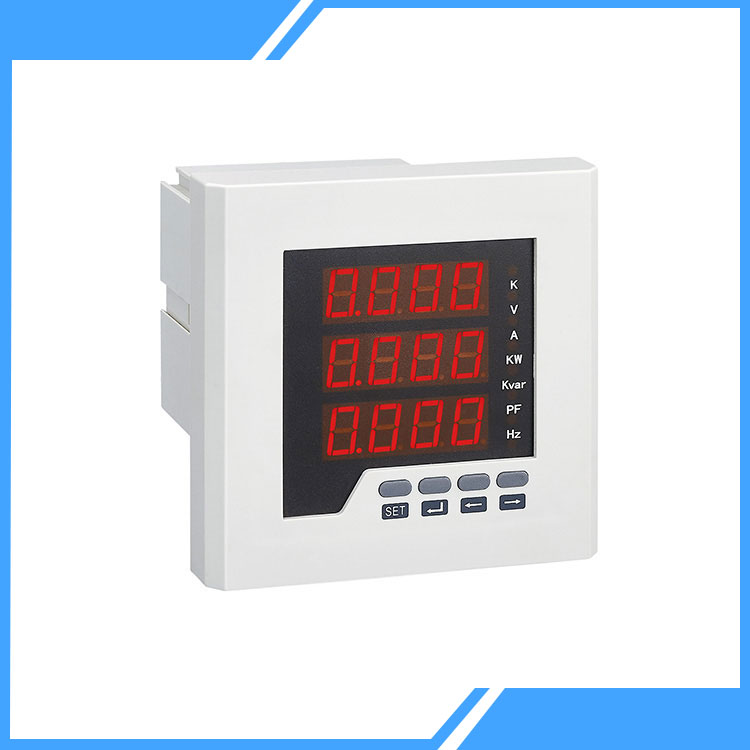
Series X provides full-electrical parameter measurement of current, voltage, power, frequency, and power factor with direct display and 0.5 accuracy class. Series K adds three analog quantity transmitting outputs (4-20mA) and optional RS485 communication interface with Modbus-RTU protocol. Series S introduces programmable alarm functionality, with relay output capabilities and telesignalization via RS-485 port — enabling the meter to actively alert operators when abnormal voltage conditions occur, rather than passively displaying values that may be overlooked.
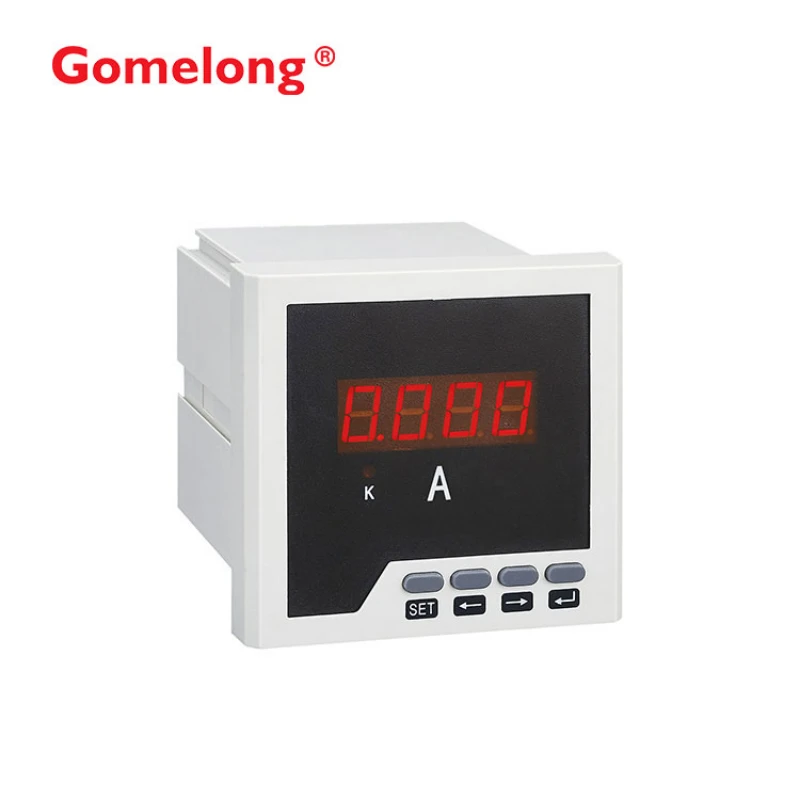
Additionally, each Gomelong single phase digital panel mount AC voltmeter features a high-quality LED display using high-cost IC chips, with programming buttons rated for up to 100,000 keystrokes. The panel construction uses imported high molecular compounds that resist acid, alkali, high temperature, and corrosion, ensuring reliable operation even in demanding industrial environments.
When evaluating a single phase digital panel mount AC voltmeter for your application, certain technical specifications provide meaningful insight into its ability to detect momentary overvoltage events.
| Parameter | Standard Offering | What It Means for Overvoltage Detection |
|---|---|---|
| Accuracy Class | 0.5 | Reliable measurement fidelity under normal conditions |
| Frequency Range | 45-65 Hz | Covers global power systems (50Hz/60Hz) |
| Measurement Method | AC sampling technique | Digital sampling of input waveform |
| Programmable Scaling | Front-panel key adjustable | Flexible ratio configuration on-site |
| Communication Protocol | Modbus-RTU (RS485) | Remote monitoring and alarm integration |
| Alarm Functionality | Available (Series S) | Active notification of abnormal voltage |
| Display Type | LED, 4 digits | High-visibility real-time readout |
For Gomelong, these specifications are not just numbers on a datasheet — they represent real-world engineering decisions made to ensure dependable operation. Our single phase digital panel mount AC voltmeter instruments are built in facilities that hold ISO 9001 quality management and ISO 14001 environmental management certifications. The meters also carry CE, ROHS, CCC, and CMC measuring licenses, along with Exporting Quality license, confirming their compliance with international standards.
A meter that detects an overvoltage is valuable. A meter that tells someone about it is indispensable. Gomelong addresses this requirement through optional RS485 communication with Modbus-RTU protocol, enabling integration with PLCs, industrial control computers, and supervisory control systems. When an overvoltage event occurs, the information can be logged, displayed on HMI screens, and used to trigger automated responses — not simply lost between display updates.
The meters are also field-programmable, allowing operators to adjust ratio parameters directly from the front panel without requiring specialized software or disconnected programming equipment. This feature simplifies commissioning and modification when system configurations change over time.
A1: The appropriate response time depends on your specific application requirements. For general power monitoring in commercial buildings, a response time of 500 milliseconds to 1 second may be acceptable for detecting longer-duration overvoltage events. However, for industrial applications involving sensitive electronic equipment, variable frequency drives, or automated control systems, a response time of 200 milliseconds or faster is strongly recommended. Many standard digital panel meters update their displays at rates between 200 and 500 milliseconds, which determines how quickly a voltage change can be reflected on the readout. It is important to note that display update rate and measurement sampling rate are related but distinct specifications. For critical applications where even brief voltage excursions could cause equipment stress or data corruption, consider meters with programmable alarm outputs that provide notification independent of the display update cycle. If your existing monitoring system cannot provide this level of responsiveness, adding a dedicated alarm-capable meter for sensitive branch circuits may offer an effective solution.
A2: Digital sampling is necessary but not sufficient for reliable momentary overvoltage detection. The key factors are the sampling rate (how frequently the meter measures the voltage), the processing algorithm (how sampled values are converted into displayed readings), and the presence of any internal averaging or damping that might filter out short-duration events. Some digital meters intentionally average multiple samples over a period of several cycles to produce a stable display, which effectively eliminates brief transient events from being shown. Other meters may sample at high rates but only update the display at much slower intervals. To determine if your single phase digital panel mount AC voltmeter is capturing transients, consult the manufacturer's specifications for both the sampling rate and the effective response time. If these specifications are not clearly documented, the meter may not be designed with transient detection as a priority. Meters that offer programmable alarm outputs and communication capabilities are generally better suited for overvoltage monitoring, as they can report events in near real-time rather than relying on an operator to observe a fleeting display change.
A3: Standard voltmeters are primarily designed to measure and display steady-state voltage values under normal operating conditions. Their engineering priorities typically include accuracy at nominal voltage, display readability, and long-term reliability. Overvoltage monitoring adds distinct requirements: faster response to voltage changes, configurable alarm thresholds, logging or communication of out-of-limit events, and the ability to function reliably in the presence of the electrical noise that often accompanies overvoltage conditions. A meter intended for overvoltage monitoring will generally offer user-adjustable high and low alarm setpoints, relay or transistor outputs for annunciation, and communication ports (such as RS485 with Modbus) for integration with control systems. For example, Gomelong offers Series S programmable alarm meters specifically designed for electricity systems and industrial mining enterprises demanding current control and detection. These meters can measure various electricity parameters with high accuracy and achieve telesignalization through RS-485 ports. The choice between a standard meter and an overvoltage-monitoring meter ultimately depends on the value of the equipment being protected and the consequences of undetected overvoltage events in your specific application.
Before concluding that your existing voltage monitoring is adequate, consider conducting a simple assessment of your current setup.
1. Response Time Verification — Locate the response time specification in your meter's datasheet. If it is not provided, contact the manufacturer directly. A missing specification often indicates that fast response was not a design priority.
2. Sampling Method Review — Understand whether your meter uses True RMS measurement, average-responding measurement, or another method. True RMS meters generally provide more accurate readings under distorted waveform conditions.
3. Alarm Capability Check — Determine if your meter can trigger an alarm or output a signal when voltage exceeds a preset threshold. Without this, you rely entirely on real-time observation by an operator.
4. Data Logging Assessment — Establish whether your meter can record minimum and maximum values, and whether it can communicate that data to a central system. A single phase digital panel mount AC voltmeter with RS485 communication and Modbus-RTU protocol offers significantly greater diagnostic value than an isolated digital display.
5. Environmental Suitability — Verify that your meter is rated for the environmental conditions present in your facility. Temperature extremes, humidity, vibration, and harmonic distortion can all affect measurement accuracy and reliability. Gomelong meters are designed to withstand challenging conditions, featuring panels made from imported high molecular compounds resistant to acid, alkali, high temperature, and corrosion.
No single instrument can capture every electrical anomaly. However, deploying a single phase digital panel mount AC voltmeter with communication capabilities, programmable alarm thresholds, and documented fast response characteristics provides a foundation for understanding your system's voltage behavior. When multiple such meters are distributed throughout a facility, their combined data can reveal patterns — such as certain processes or times of day associated with repeated overvoltage events — that would remain invisible with slower, isolated measurement devices.
The question posed in the title — What if your single phase digital panel voltmeter misses a momentary overvoltage? — is not merely hypothetical. In thousands of facilities around the world, it is happening every day. Voltage spikes come and go in milliseconds. Displays update in fractions of a second. The gap between these two timelines determines whether a problem is documented or invisible.
The best time to evaluate your voltage monitoring capabilities is before a preventable failure occurs, not after. A thoughtful review of your existing meters' specifications, followed by strategic upgrades where gaps exist, can transform how you understand and protect your electrical infrastructure.
With Gomelong's range of single phase digital panel mount AC voltmeter instruments — from basic measurement (Series X) to analog output (Series K) to programmable alarm functionality (Series S) — operators and facility managers have options that align with their specific monitoring requirements and budget considerations. All products in our portfolio are built in ISO-certified facilities, backed by CE, ROHS, and CCC certifications, and supported by a company committed to technological innovation and customer success.